

What is Collagen?
Collagen is a protein that serves as one of the main building blocks for your bones, skin, hair, muscles, tendons, and ligaments. It’s essentially the substance that holds the body together. Collagen forms a scaffold to provide strength and structure, playing a vital role in maintaining skin elasticity and firmness.
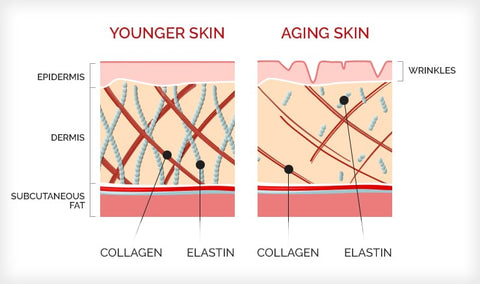
Aging has a detrimental effect on connective tissue in the skin, leading to declines in elastin and collagen fibers and thus resulting in fine lines and wrinkles. Furthermore, aging reduces the production of proteoglycans and glycosaminoglycan (such as hyaluronic acid) in the skin, as well as cartilage. As a result, skin tissue weakens, losing its integrity, and the skin becomes dry, unable to retain enough moisture. Although multiple intrinsic processes can affect the aging process, factors such as exposure to sun, liquid intake, lifestyle, and pollution can exacerbate the aging process. Moreover, skin wrinkling also progresses as dermal thickness is reduced over time due to decreased collagen.
The Efficacy of Collagen in Reducing Wrinkles
A study conducted by Sanz et al. in 2015 found that women who used collagen product had better results than those in the control group. About three-quarters of the treated women showed anti-wrinkling effects and significant increases in skin density and elasticity after just seven days of treatment. Similarly, Matthias et al. conducted a retrospective study on 480 patients with wrinkles, lax skin, scarring, and stretch marks in Germany and South Africa.
These patients used topical collagen after preparing their skin with vitamins and creams for a month. The results showed a 60% to 80% improvement in skin condition. A histological examination revealed a substantial increase in collagen and elastin deposition, with a 40% thickening of the epidermis, mainly in the stratum spinosum, one year after treatment. Campos et al. evaluated the effects of both topical and oral collagen on 60 healthy women. Their findings indicated that women who used a topical collagen product had a significant increase in skin hydration and elasticity within one month.
Another group with oral supplementation showed more noticeable improvements in skin density and pore size reduction after three months without adverse effects. This study confirmed that patients receiving collagen treatment had a notable reduction in the total wrinkle surface, number of wrinkles, and average wrinkle length and depth compared to those using a placebo.
In 2010, Byrne et al. reported the anti-wrinkle activity of collagen. Their research suggested that supplementation significantly improved photo-damaged skin within one month compared to a placebo group. These studies revealed noteworthy reductions in the number of wrinkles and total wrinkle surface, alongside an increase in mean depth and length of wrinkles by the end of one month, ranging from 10% to 28%.
Slowing the aging process by use of collagen supplements has become a driving force in the field of dermatology and cosmetics. The evidence from the reviewed studies suggested that both collagen supplements improve skin moisture, elasticity, and hydration when orally administered. Additionally, collagen reduces the wrinkling and roughness of the skin, and existing studies have not found any side effects of its oral supplements.
source : https://www.ncbi.nlm.nih.gov/pmc/articles/PMC8824545/
1 comment
What about men is it good for men as well
———
MISMO Body Care replied:
Hi Jai,
Yes, absolutely — collagen works the same way for men’s skin as it does for women’s, it’s not gender-specific. Skin loses collagen with age regardless, so it supports elasticity and helps with fine lines either way. Plenty of our male customers take it for exactly that reason.
Thanks,
Mimso family