

WHAT IS SODIUM HYALURONATE?
Sodium hyaluronate is a sodium salt that's been synthesized to form smaller molecules for stability and oxidation resistance. This smaller molecule weight enables greater penetration and hydration at deeper levels. It is used in various forms for medicinal purposes as well as cosmetic skincare products and is particularly useful when included in an active serum formulation.
Skin care uses
If you look closely, you will often find sodium hyaluronate as a key ingredient in a range of skincare products such as creams, gels, lotions, and serums. It is a powerful ingredient as it offers superior hydration by drawing in moisture to deeply hydrate and plump the skin, and support collagen integrity.
Eyes, Body, and Healthcare
In addition to skincare products, sodium hyaluronate also plays a role in treating several medical conditions and is a primary ingredient for the following health conditions:
-
Dry Eyes: Hyaluronate is often used in eye drops to help lubricate and soothe dry eyes.
-
Osteoarthritis: In cases where the synovial fluid has deteriorated in joints due to arthritic conditions or wear and tear, injecting sodium hyaluronate into the joints can help lubricate and cushion joints, reducing pain.
-
Cystitis: Sodium hyaluronate can be used as an intravesical treatment for interstitial cystitis. The solution coats the lining of the bladder to significantly reduce pain and improve the quality of life.
REVIEWING THE DIFFERENCE BETWEEN HYALURONIC ACID AND SODIUM HYALURONATE
The main differences between sodium hyaluronate and hyaluronic acid are that the former has a smaller molecular weight and is water-soluble, allowing for deeper penetration and greater moisture retention. While both provide similar benefits, this difference in molecular weight results in different mechanisms of action.
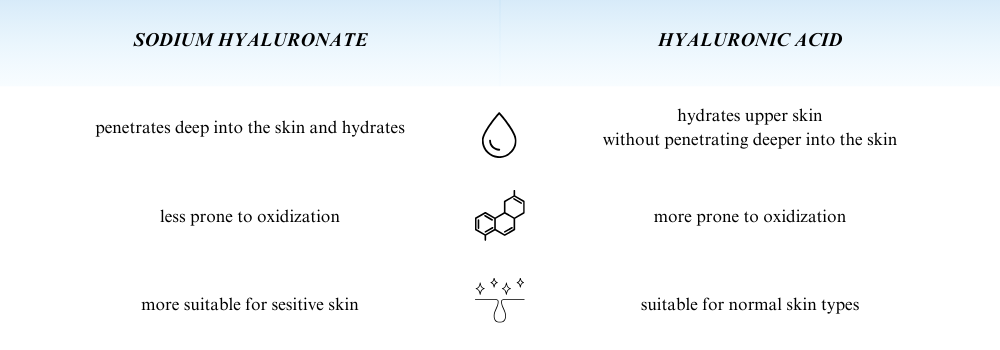
Sodium hyaluronate works deep within the layers of the skin to hydrate, while hyaluronic acid, which often has a larger molecular size, is better suited to protect the surface skin from water loss. Both support collagen via increased water retention, enabling collagen to stretch without breaking.
Another difference is that sodium hyaluronate is less susceptible to oxidation, making it more stable. This is an important consideration, particularly when it is introduced through an active serum. Both are found within skincare products and are prized for their hydrating, plumping, and anti-aging benefits.
Sodium hyaluronate offers multiple skincare benefits, working wonders to plump up and revitalize the skin, combat the signs of aging, and support overall skin health. Here are some of its unique advantages:
Oily and Problematic Skin
With its small molecular size, sodium hyaluronate is less prone to clogging, making it an ideal hydrating solution for oily and problematic skin conditions. It effectively boosts hydration, penetrating the deeper layers of the skin between connective tissues, absorbing and retaining moisture. This action eliminates dryness and flaking, improves skin firmness, and reduces the appearance of fine lines and wrinkles.
In a study examining the effects of creams, serums, and lotions containing sodium hyaluronate, researchers observed significantly hydrated, smoothed, and elastic skin at 2, 4, and 8 weeks of treatment. The link between smaller molecular weight and greater hydration was confirmed by the researchers.
Smooths Wrinkles and Fine Lines
Sodium hyaluronate, a powerful humectant, draws and retains moisture within the skin, preventing the formation of future lines. Proven to be an effective anti-aging treatment, a study examining various types of hyaluronic acid found that the low molecular weight of sodium hyaluronate improved both skin moisture and elasticity while significantly reducing wrinkle depth.

WHAT ABOUT ACNE SKIN?
We all know acne conditions can pose a lot of problems and are notoriously difficult to treat. Many people with acne-prone skin are typically using one or more medicated skincare products to treat their symptoms. Unfortunately a side effect of these can be dry and irritated skin. This may cause an overproduction of oil, in turn causing more breakouts. Sodium hyaluronate is considered safe for all skin types and is non-comedogenic, ensuring it won't clog pores.
Companion Ingredients to Sodium Hyaluronate
Products that feature sodium hyaluronate as their primary ingredient often incorporate additional ingredients to achieve optimal results. This is because the hydrating effects of sodium hyaluronate can be enhanced through the introduction of other beneficial ingredients, such as:
-
Peptides: Peptides also possess water-binding properties, complementing the hydrating capabilities of sodium hyaluronate.
-
Glycerin: Glycerin is an excellent moisturizing ingredient known for enhancing hydration levels.
-
Hyaluronic Acid: Hyaluronic acid, while similar to sodium hyaluronate, works on the surface level to draw in moisture and prevent water loss, complementing the deeper action of sodium hyaluronate.
-
Vitamin A: Vitamin A is included for its anti-aging and collagen-boosting benefits.
-
Vitamin C: Vitamin C is incorporated for its anti-aging and wound-healing properties.
-
Vitamin E: Vitamin E is added to nourish and protect the skin.
By combining these companion ingredients, skincare products can offer a comprehensive approach to hydration, anti-aging, and overall skin health, providing users with a well-rounded and effective skincare experience.
WHICH IS BETTER?
Sodium Hyaluronate is a synthesised, salt form of hyaluronic acid. While it can provide the same benefits, the mechanism by which it works is different. Due to its much smaller molecular weight, sodium hyaluronate is able to deeply penetrate the skin unlike hyaluronic acid.
It attracts and binds to water, which allows moisture levels to be maintained in the deeper layers of the skin. This allows hydration of the top layers, supporting collagen and effectively forms and strengthens the skin, plumping and improving the look of fine lines.
While both are similar, if you are seeking deeper penetration we recommend sodium hyaluronate as due its ability to give better results from its size and stability as an active ingredient. At MISMO we only use sodium hyaluronate, which can be found in these products;
0 comments